baseball pitcher workout pdf
Summary
Level up your fastball! Get a free, downloadable PDF with proven baseball pitcher workouts. Dominate the mound with drills for strength, speed & endurance. Start training now!

Baseball Pitcher Workout Plan: A Comprehensive Guide
This guide details essential workouts for baseball pitchers, focusing on dynamic warm-ups, strength training, and core exercises to enhance velocity and prevent injuries.
Baseball pitcher training is a specialized field, demanding a nuanced approach distinct from general athletic conditioning. Effective training isn’t simply about building strength; it’s about optimizing the kinetic chain for explosive pitching mechanics while safeguarding the arm. Many pitchers inadvertently follow generic strength programs, overlooking the unique biomechanical stresses inherent in throwing.
A comprehensive plan must address the complex interplay between lower body drive, core stability, and upper body power. Prioritizing arm care, particularly rotator cuff strengthening, is paramount for injury prevention. This guide provides a structured framework, encompassing in-season and off-season protocols, warm-up routines, strength and plyometric exercises, and recovery strategies.
We will explore how to tailor workouts to individual needs, emphasizing proper mechanics and progressive overload. Ultimately, the goal is to maximize pitching velocity, improve control, and ensure long-term durability. Accessing a printable, step-by-step practice plan can be incredibly beneficial for implementation.
II. Understanding the Unique Demands of Pitching
Pitching is arguably the most complex and violent movement in sports, placing extraordinary demands on the musculoskeletal system. Unlike many athletic endeavors focused on symmetrical movements, pitching is inherently asymmetrical, creating imbalances and heightened injury risk. The shoulder and elbow endure immense stress during each throw, requiring specialized conditioning to withstand these forces.
Effective training must recognize that pitching isn’t solely about arm strength. Leg drive, core rotation, and efficient kinetic sequencing are crucial for generating velocity and minimizing strain on the upper body. A strong core provides stability and facilitates power transfer, while lower body strength fuels the pitching motion.
Ignoring these interconnected elements can lead to decreased performance and increased susceptibility to injury. Therefore, a well-rounded program must address all aspects of the pitching delivery, focusing on building a resilient and powerful foundation.
III. In-Season vs. Off-Season Training
The approach to pitcher training must drastically shift between the in-season and off-season. Off-season training prioritizes building a robust physical base – focusing on strength gains, muscle hypertrophy, and addressing any biomechanical deficiencies. This phase allows for higher volume lifting and more extensive recovery periods, preparing the body for the demands ahead.
Conversely, in-season training centers around maintenance and recovery. The goal isn’t to build strength, but to preserve existing strength while managing fatigue and preventing injury; Workouts become shorter, less frequent, and emphasize recovery modalities like active recovery techniques and targeted arm care.
Pitchers require a tailored plan that acknowledges the cumulative stress of pitching. Overdoing it during the season can lead to burnout and injury, while neglecting training altogether can result in performance decline. Finding the right balance is paramount.
IV. Warm-up Routine for Pitchers
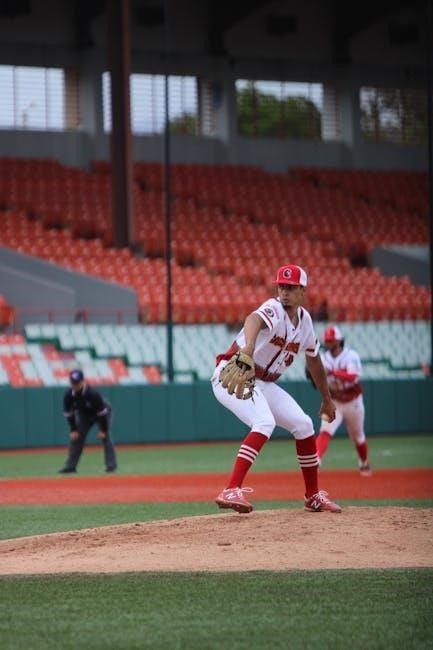
A comprehensive warm-up is non-negotiable for pitchers, preparing the body for the explosive demands of throwing. It’s a progressive process, starting with general movements to increase blood flow and core temperature, then transitioning to more specific exercises mimicking pitching mechanics.
The warm-up should be divided into two key phases: dynamic stretching and arm care. Dynamic stretching improves range of motion and flexibility, while arm care focuses on activating and strengthening the rotator cuff muscles – crucial for shoulder stability and injury prevention.
Prioritize movements like arm circles, torso twists, leg swings, and high knees. Follow this with exercises like band pull-aparts, external rotations, and internal rotations. A proper warm-up isn’t just about preventing injury; it’s about optimizing performance.
A. Dynamic Stretching (Pre-Throwing)
Dynamic stretching prepares muscles for activity, unlike static stretching which can temporarily reduce power. Prioritize movements that mimic the pitching motion, increasing blood flow and range of motion. Begin with general full-body movements, then progress to more specific exercises.
Effective dynamic stretches include arm circles (forward and backward), torso twists, leg swings (forward, backward, and lateral), and high knees. Walking lunges with a twist are also beneficial, engaging the core and improving hip mobility. Don’t forget inchworms, which dynamically stretch the hamstrings and shoulders.
Each stretch should be performed for 10-15 repetitions, focusing on controlled movements rather than bouncing. The goal is to gradually increase flexibility and prepare the muscles for the stress of throwing. This phase is crucial for injury prevention and maximizing performance.
B. Arm Care Exercises (Rotator Cuff Focus)
Robust rotator cuff health is paramount for pitchers, preventing injuries and maintaining throwing velocity. These muscles stabilize the shoulder joint during the high-stress pitching motion. Arm care isn’t just for injury recovery; it’s preventative maintenance.
Essential exercises include external and internal rotations using resistance bands, focusing on slow, controlled movements. Scaption exercises (raising the arm at a 30-degree angle) strengthen the supraspinatus. Sleeper stretches improve internal rotation range of motion.
Perform 2-3 sets of 15-20 repetitions for each exercise, using light resistance. Proper form is crucial; avoid compensating with other muscles. Incorporate these exercises daily, even on non-throwing days, to build and maintain shoulder stability. Consistency is key to long-term arm health.
V. Strength Training for Pitchers
Strength training is foundational for pitching performance, building the necessary power and stability. It’s not about bulk; it’s about functional strength tailored to the pitching motion. Many pitchers benefit from routines not designed for throwing, highlighting the need for specificity.
Focus on lower body strength with exercises like squats, lunges, and deadlifts to generate leg drive. Core strength is vital for transferring power – incorporate planks, Russian twists, and medicine ball rotations. Upper body work should prioritize shoulder and back strength, using pull-ups, rows, and push-ups.
Aim for 3-4 strength training sessions per week during the off-season, reducing frequency during the in-season to maintain strength without fatigue. Prioritize proper form and controlled movements to prevent injury.
A. Lower Body Strength (Leg Drive & Power)
Developing lower body strength is paramount for pitching velocity, as leg drive initiates the kinetic chain. Exercises should focus on building explosive power and stability. Squats are fundamental – begin with bodyweight squats and progress to barbell squats, focusing on depth and controlled descent.
Lunges, both forward and reverse, enhance single-leg stability and power. Deadlifts build overall strength and posterior chain development, crucial for generating force. Incorporate plyometric exercises like box jumps and split squat jumps to improve explosive power.
Aim for 3 sets of 8-12 repetitions for each exercise, prioritizing proper form over weight. Remember, the goal isn’t just strength, but the ability to transfer that strength into rotational power on the mound.
B. Core Strength (Stability & Rotation)
A strong core is the foundation of efficient pitching mechanics, providing stability and facilitating rotational power; Exercises should target all core muscles – rectus abdominis, obliques, and lower back. Planks, in various forms (forearm, side, with leg lifts), build isometric strength and endurance.
Russian twists with a medicine ball enhance rotational power, mimicking the pitching motion. Wood chops, using a cable machine or resistance band, further develop rotational strength. Dead bugs improve core stability and control.
Focus on controlled movements and maintaining a neutral spine throughout each exercise. Aim for 3 sets of 15-20 repetitions for most exercises, increasing resistance as strength improves. A stable core allows for optimal energy transfer from the lower body to the upper body.
C. Upper Body Strength (Shoulder & Back)
Developing upper body strength is crucial for pitching velocity and endurance, but must be balanced with flexibility and rotator cuff stability. Focus on exercises that strengthen the shoulder girdle, back muscles, and chest. Pull-ups and lat pulldowns build back strength, essential for scapular control.
Dumbbell rows and face pulls target the posterior shoulder muscles, counteracting the internal rotation common in pitching. Push-ups and bench press (with moderate weight) strengthen the chest and anterior shoulder. External rotations with resistance bands are vital for rotator cuff health.
Prioritize proper form to avoid injury. Incorporate 3 sets of 8-12 repetitions for strength exercises, and higher reps (15-20) for rotator cuff work. Remember, strength is a component, not the sole focus.
VI. Plyometric Exercises for Pitching Velocity
Plyometrics are essential for developing explosive power, translating to increased pitching velocity. These exercises train the muscles to exert maximum force in short intervals, mimicking the pitching motion. Begin with a solid strength base before introducing plyometrics to minimize injury risk.
Box jumps and variations (single leg, lateral) improve leg power and explosiveness. Medicine ball throws, particularly rotational throws against a wall, enhance core and upper body rotational power. Split squat jumps and depth jumps further develop lower body explosiveness.
Focus on proper landing mechanics and controlled movements. Start with low-intensity plyometrics and gradually increase the intensity and volume. Incorporate 2-3 plyometric sessions per week, allowing for adequate recovery between sessions.
A. Box Jumps & Variations
Box jumps are a foundational plyometric exercise for pitchers, building explosive leg power crucial for generating velocity. Start with a box height appropriate for your current fitness level, prioritizing proper form over height. Focus on a soft landing, absorbing the impact through your hips, knees, and ankles.

Variations include single-leg box jumps, increasing the challenge to stability and unilateral power. Lateral box jumps improve side-to-side explosiveness, beneficial for fielding and rotational movements. Consider depth jumps – stepping off the box and immediately jumping – for advanced athletes, but proceed cautiously.
Perform 3-4 sets of 5-8 repetitions with adequate rest between sets. Prioritize quality over quantity, ensuring each jump is explosive and controlled. Gradually increase box height as strength and power improve.
B. Medicine Ball Throws (Rotational Power)
Medicine ball throws are vital for developing rotational power, mimicking the pitching motion and enhancing core stability. Several variations target different aspects of pitching mechanics. Chest passes build forward power, while rotational throws with a partner emphasize trunk rotation and hip drive.
Overhead slams improve shoulder strength and power, crucial for arm speed. Wood chops, performed diagonally across the body, engage the obliques and enhance rotational control. Focus on generating power from your legs and core, not just your arms.
Perform 3-4 sets of 8-12 repetitions for each variation, using a medicine ball weight appropriate for your strength level. Maintain proper form throughout each throw, prioritizing controlled movements and explosive power.
VII. Long Toss Program
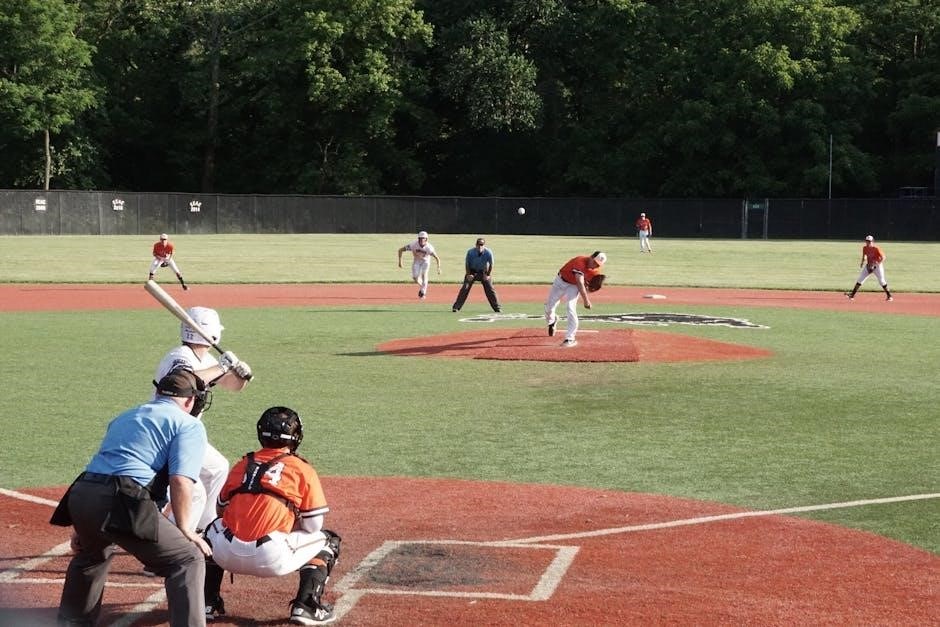
A well-structured long toss program is fundamental for building arm strength and endurance, preparing pitchers for the demands of the season. This isn’t simply throwing as far as possible; it’s a progressive process focused on proper mechanics and gradual distance increases.
Begin with shorter distances, focusing on a smooth, controlled throwing motion. Gradually increase the distance in increments, prioritizing accuracy and maintaining good form. Avoid forcing throws or compromising mechanics to achieve greater distance. Listen to your body and adjust the program as needed.
A typical progression might start at 60 feet, increasing to 90, 120, and eventually 150+ feet. Incorporate variations like four-seam fastballs and curveballs at appropriate distances. Proper mechanics are paramount; long toss should reinforce, not create, bad habits.
A. Progression & Distance Guidelines
Implementing a smart progression is crucial for a safe and effective long toss program. Start conservatively, especially during the off-season, with throws beginning around 60 feet. Focus on a smooth, controlled motion, prioritizing accuracy over sheer distance. Increase distance incrementally – perhaps 10-15 feet per session – only when mechanics remain sound.
A sample progression could look like this: Weeks 1-2: 60-90 feet; Weeks 3-4: 90-120 feet; Weeks 5-6: 120-150 feet, and beyond. Monitor arm fatigue closely. If discomfort arises, reduce distance immediately. Vary pitch types as distance increases, incorporating fastballs and breaking balls.
Avoid sudden jumps in distance. Gradual increases allow the arm to adapt and strengthen. Remember, the goal isn’t maximum velocity during long toss, but building a strong, durable throwing base.
B. Importance of Proper Mechanics
Maintaining sound mechanics during long toss is paramount, even more so than achieving maximum distance. Faulty mechanics can place undue stress on the arm, increasing injury risk and hindering development. Focus on a consistent, repeatable delivery, emphasizing a strong lower half and efficient energy transfer.
Pay attention to key mechanical elements: a proper stride length, a stable front shoulder, and a full arm path. Video analysis can be incredibly valuable for identifying and correcting mechanical flaws. Don’t sacrifice form for velocity; prioritize a clean, efficient motion.
Long toss isn’t just about arm strength; it’s about reinforcing good habits. Consistent, mechanically sound throws build muscle memory and improve overall throwing efficiency, ultimately translating to increased velocity and control on the mound.
VIII. Recovery & Injury Prevention
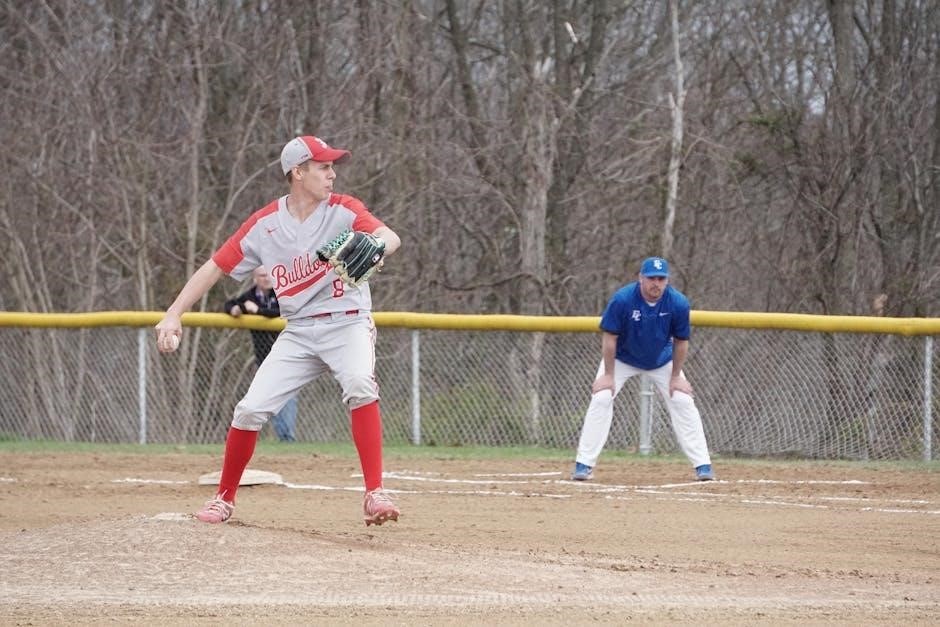
Recovery is as crucial as the workout itself for a pitcher’s longevity and performance. A comprehensive post-workout cool-down should include static stretching, holding each stretch for 30 seconds, targeting major muscle groups used during pitching – shoulders, elbows, forearms, hips, and legs.
Active recovery techniques, like light jogging or swimming, promote blood flow and reduce muscle soreness. Prioritize sleep, aiming for 8-9 hours per night, as this is when the body repairs and rebuilds. Proper nutrition, with adequate protein intake, is also vital for muscle recovery.
Proactive injury prevention involves consistent arm care, rotator cuff exercises, and addressing any discomfort immediately. Ignoring pain can lead to more serious injuries. Listen to your body and don’t push through pain.
A. Post-Workout Cool-down & Stretching
A dedicated post-workout cool-down is non-negotiable for pitchers, transitioning the body from high intensity to a resting state. Begin with 5-10 minutes of light cardio, such as jogging or easy cycling, to gradually decrease heart rate and blood pressure.
Static stretching should follow, holding each stretch for 30 seconds. Focus on major muscle groups: shoulders (cross-body stretch, overhead triceps stretch), elbows (forearm flexor/extensor stretch), chest (doorway stretch), hips (butterfly stretch, hamstring stretch), and legs (quadriceps stretch, calf stretch).
Prioritize stretches that target the pitching motion’s key muscles. This improves flexibility, reduces muscle soreness, and helps prevent injuries. Consistent cool-downs enhance recovery and prepare the body for the next training session.
B. Active Recovery Techniques
Active recovery is crucial for pitchers, promoting blood flow and reducing muscle soreness without imposing significant stress. Unlike complete rest, active recovery keeps the body moving, accelerating healing and preventing stiffness.
Low-intensity activities are ideal: light swimming, walking, cycling, or even dynamic stretching; Foam rolling is also highly effective, targeting muscle knots and improving tissue quality. Spend 10-15 minutes focusing on the shoulders, back, legs, and core.

Contrast baths – alternating between hot and cold water – can reduce inflammation and promote recovery. Prioritize sleep and proper nutrition to support the body’s natural repair processes. Active recovery isn’t about pushing limits; it’s about facilitating restoration.
IX. Sample Day 1 Workout (Post-Start Recovery)
Day 1, immediately following a start, prioritizes recovery. This isn’t a strength-building session, but a crucial step in mitigating fatigue and preparing for the next outing. The focus is on restoring blood flow and reducing muscle soreness.
Begin with 10-15 minutes of light cardio, like walking or cycling. Follow this with dynamic stretching, emphasizing shoulder mobility and torso rotation. Incorporate rotator cuff exercises – band pull-aparts, external rotations – using light resistance and high repetitions (2-3 sets of 15-20 reps).
Include 10-15 minutes of foam rolling, targeting major muscle groups. Finish with static stretching, holding each stretch for 30 seconds. Hydration and proper nutrition are paramount on this day, supporting the body’s natural recovery mechanisms.
X. Advanced Pitcher Workout Drills
For experienced pitchers seeking to elevate performance, advanced drills introduce complexity and challenge. Weighted ball training, using balls 5-10% of bodyweight, builds strength and endurance, but requires careful progression to avoid injury. Start with short, controlled throws, gradually increasing distance.
Sleeve workouts, utilizing resistance bands or weighted sleeves, enhance arm speed and stability. These drills focus on maintaining proper mechanics under increased load. Implement plyometric variations, like depth jumps and single-leg hops, to improve explosive power.
Focus on rotational power drills, incorporating medicine ball throws with varied angles and velocities. Remember, proper form is crucial; prioritize quality over quantity. These drills should supplement, not replace, foundational training.
A. Weighted Ball Training
Weighted ball training is a powerful tool for increasing arm strength and endurance, but demands a cautious approach. Begin with balls weighing 5-10% of the pitcher’s body weight, prioritizing controlled movements over maximal effort. Initial throws should be short, focusing on maintaining impeccable mechanics – mirroring the motion of a regular pitch.
Gradually increase throwing distance as comfort and control improve, never sacrificing form. This method builds resilience in the shoulder and elbow, preparing them for the stresses of high-velocity pitching. However, overuse can lead to injury; limit weighted ball sessions to 2-3 times per week.
Monitor for any signs of fatigue or discomfort and adjust the program accordingly. Weighted ball work is best integrated into an existing, well-rounded training plan.
B. Sleeve Workouts
Sleeve workouts utilize resistance sleeves, typically worn on the throwing arm, to enhance neuromuscular activation and improve throwing mechanics. These sleeves provide varying levels of resistance, challenging the muscles throughout the entire throwing motion. Begin with lighter resistance and focus on maintaining proper form, emphasizing a smooth and efficient delivery.
Sleeve work is excellent for reinforcing correct mechanics and building arm speed. It’s crucial to avoid compensating for the added resistance by altering the natural throwing motion. Sessions should be relatively short, consisting of 20-30 throws, and incorporated 1-2 times per week.
Pay close attention to any discomfort or changes in throwing mechanics, adjusting resistance or discontinuing the exercise if needed. Sleeve workouts are a valuable supplement to a comprehensive pitcher training program.
XI. Creating a Personalized Workout Plan
Developing a truly effective pitcher workout plan requires careful consideration of individual needs, throwing mechanics, and training age. Avoid generic programs; instead, prioritize exercises that address specific weaknesses and enhance existing strengths. A thorough assessment of movement patterns and physical capabilities is paramount.
Consider the pitcher’s role, game schedule, and recovery capacity when designing the plan. In-season workouts should focus on maintenance and recovery, while off-season training allows for more intensive strength and conditioning. Regularly monitor progress and adjust the plan accordingly.
Collaboration with a qualified strength and conditioning coach, alongside the pitching coach, is highly recommended. A personalized plan maximizes potential, minimizes injury risk, and optimizes performance on the mound.